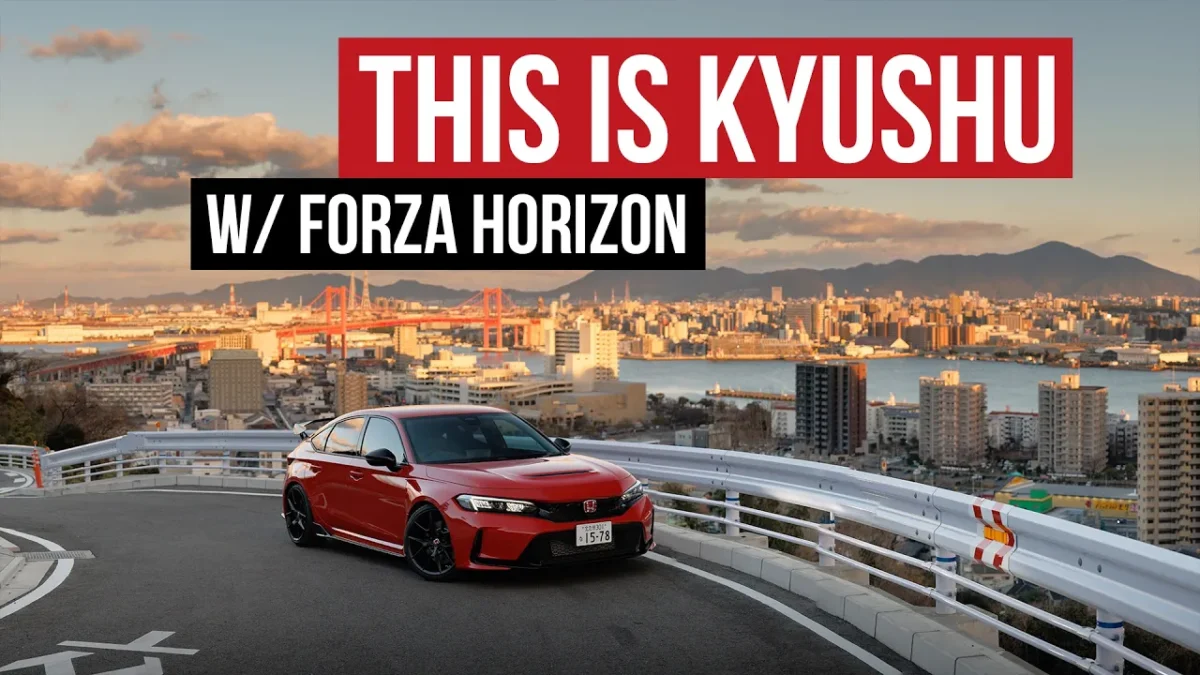
Somewhere in Kyushu, on a mountain road that rises 700 metres above sea level into a national park, photographer Larry Chen is attempting to control a Honda Civic Type R FL5 on winter tyres. The car is spinning its front wheels in third gear. The road surface is glazed with fresh snow. The scenery looks so unrealistically perfect that it could plausibly have been generated by a computer.
It wasn’t. That’s the point.
Chen was in southern Japan as part of a project for Microsoft, shooting content to support the launch of Forza Horizon 6 — the game’s largest and most ambitious instalment, set in Japan, which landed on Xbox and PC on May 19, 2026. The premise was straightforward: drive around one of the world’s most cinematically compelling countries with a Civic Type R and a local artist, and document what you find. What he found, as the footage makes clear, is that the real thing is considerably more interesting than any digital facsimile could replicate.
The Most Detailed Japan a Game Has Ever Built
Forza Horizon 6 was setting records before its release. The game features over 550 cars, including a substantial roster of JDM classics, a Tokyo City environment described as five times larger than any urban setting the series has created before, seasonal transformations inspired by Japan’s 72 micro-seasons, world-famous routes recreated in digital form including the C1 loop and Ginkgo Avenue, and mountain passes based on real locations. It is the most detailed representation of Japan a driving game has ever attempted.
What’s Not on the Map
And yet, pulling over on the Milk Road near Mount Aso in Kumamoto Prefecture — a volcanic region of extraordinary beauty, active but presently calm, with evidence of geological activity in every direction, steam rising from vents in the earth, the air carrying the particular sharp note of sulphur — none of that is in the game. The game has snow-capped mountains and canyon roads. The real Kyushu has geothermal springs that heat private baths in hillside hotels, villages where food is cooked directly in steam jets emerging from the ground, roads that traverse volcanic craters, and car enthusiasts living on islands of 30,000 people who build 800-horsepower R32 GT-Rs from salvage in workshops the size of a double garage.
A 330 PS Sightseeing Vehicle
The FL5 Civic Type R, it is worth noting, is somewhat wasted as a vehicle for sightseeing in sulphurous volcanic terrain but remains one of the more interesting propositions in the performance car market. The Japanese market version produces 330 PS — ten more than the US-specification car, attributed to the higher octane fuel available domestically. Six-speed manual, front-wheel drive, the same K20C1 two-litre turbocharged four-cylinder that Honda has been refining for years. On a dry road with proper tyres, it is an animal. On winter tyres on a snow-dusted volcanic mountain pass, it is a somewhat different kind of animal. Chen notes it spins its front wheels into third gear on the slippery surface. This is presented as a feature rather than a problem.
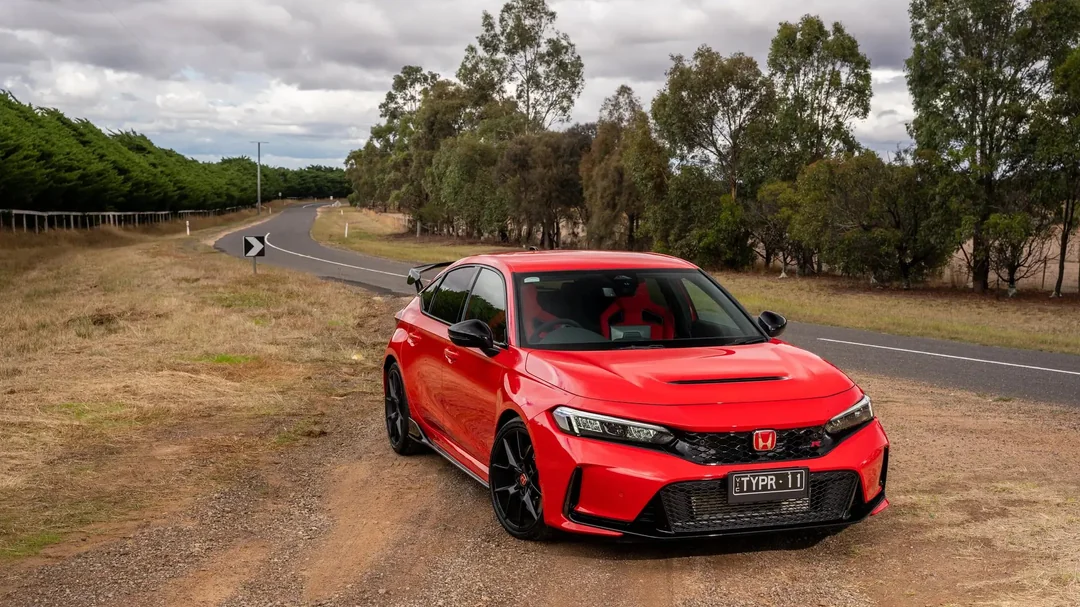
The Civic Type R has been in continuous production since 1997, which is worth acknowledging. Nearly three decades and six generations of what is essentially the same idea: take the most performance-focused version of Honda’s mass-market compact car, give it the angriest four-cylinder Honda knows how to build, fit a manual gearbox and limited-slip differential, and charge approximately fifty thousand US dollars for it. The formula is barely distinguishable from what Honda was doing with the EK9 in the late 1990s. This is a compliment.
The Island With Five Car People
The island of Fukue, reached by hydrofoil from Nagasaki in approximately ninety minutes, has a population of around 30,000 and, by one enthusiast’s count, approximately five or six car people. One of them runs a workshop that contains a named RWB 964, an 800-horsepower R32 GT-R under construction for a daughter who intends to race it in the US at TX2K, a twin-turbocharged S30 Nissan Z built around a 3.0-litre diesel-crank L-series engine, a Bluebird with a rear-mounted radiator and a transverse FJ20 engine, a collection of motorcycles, custom headers fabricated in-house, and a machine shop. The man who runs it works alone, does everything himself, and has been building cars on this island for as long as anyone can remember.
What the Game Can’t Render
This is the thing that the game cannot capture and the journey can. Forza Horizon 6 renders Japan’s geography with extraordinary fidelity. It includes the mountain passes and the canyon roads and the city streets and the four seasons. What it cannot include is the ramen vendor in Nagasaki’s Chinatown who has been operating his street cart for 33 years, who is one of the last three such vendors left in the city, and who will not be replaced when he retires because no new permits are being issued. Chen met him, ate his ramen, paid 650 yen for a bowl, and later mailed the old man photographs because he and his wife don’t have email addresses. The game cannot mail anyone photographs.
Now the Game Is Out
Since launch, the game has largely delivered on the geography — and, interestingly, made a genuine attempt at the culture too. The new Aftermarket Cars system scatters secondhand modified cars around the map to be discovered, test-driven and bought, complete with someone else’s body kits and tuning choices already installed — which is about as close as a game has come to the experience of finding the right car on the right classifieds site at the right moment. Car Meets recreate the Daikoku parking area ritual as a multiplayer social space, and Touge Battles are now a standalone mode with the fog, the drops and the Initial D inheritance fully intact.
The debate that has emerged since launch, though, proves this article’s premise better than we could have hoped. The critique circulating among Japanese car culture writers is not that the map is wrong — it’s that the culture is thinner than the geography: the bōsōzoku, kaidō racer and shakotan styles largely absent, the social texture of the scene rendered as a feature list. Which is another way of saying what Chen’s journey said in April: a game can model the roads with extraordinary fidelity, but the culture that matters most exists off-screen, often deliberately so — some of it actively avoiding being found.
Forza Horizon 6 is selling millions of copies and introducing a generation of players to the geography and car culture of Japan through a screen — the same pipeline that once ran through a certain film franchise, with similar downstream effects to come. Some of those players will eventually get on a plane and discover that the mountain roads are steeper and more narrow than the game suggests, the food is considerably better, the car builders are more interesting, and the sulphur smells exactly as strong as you’d expect from something coming directly out of a volcano.
That is, of course, entirely the point.