There is a workshop in southern Japan where the world’s most famous Skyline is being rebuilt in carbon fibre, one obsessive panel at a time, for $375,000 a car — and the waiting list suggests the price is right.
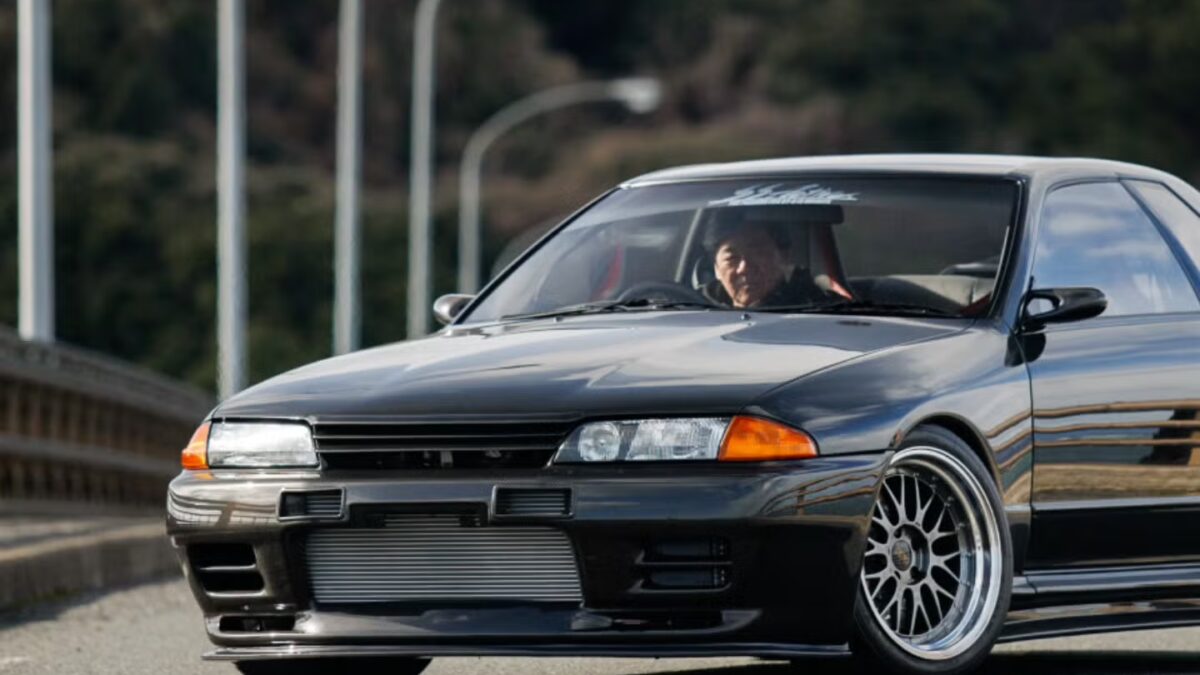
The car in question is the R32 Skyline GT-R, known to those who grew up on Gran Turismo and late-night YouTube rabbit holes as Godzilla. The version Sakamoto-san has just completed is not Godzilla. It is Godzilla if Godzilla had gone on an extreme diet, hired a tailor, and developed a passion for motorsport-grade carbon fibre.
The Build: Godzilla in Dry Carbon
Photographer Larry Chen recently visited Garage Active’s base, and the footage tells the story better than any press release could. The build is a narrowbody R32 GT-R — notable in itself because Garage Active previously showed a widebody version — constructed almost entirely from dry carbon fibre. Hood, roof, door panels, trunk, front bumper, rear bumper, interior. Carbon. The whole lot. Nine coats of clear to protect the weave, painted dry carbon being, as Sakamoto-san patiently explains, extraordinarily difficult to get right.
The result weighs 1,370 kilograms; stock R32 GT-Rs run roughly 1,430 to 1,500 kilograms depending on variant. Call it a diet of 60 to 130 kilograms, taken out of a car that was already considered one of the more athletic machines of its era.
The engine is an HKS 2.8-litre stroker, twin-turbocharged, producing somewhere north of 700 horsepower. The important distinction is that Sakamoto-san tuned it for throttle response rather than peak power — the opposite of the arms race that typically accompanies builds of this ambition. It runs a five-speed OS Giken transmission with a lightweight competition clutch. It has a full interior. Recaro seats. Working air conditioning. The rear seats, remarkably, were not deleted.
This is not a track weapon. It is, by all accounts, a road car. A road car that costs $375,000, that will tour the world for approximately a year before the customer who commissioned it is allowed to take delivery, and that represents the distilled obsession of one craftsman in one workshop on one Japanese island.
Why the R32 GT-R Matters
The context matters here. In Japan’s Group A touring car championship, the R32 GT-R won 29 races from 29 starts — a record so complete it reads like a typo. In Australia it won Bathurst twice, collected consecutive touring car titles, and so thoroughly demoralised the local V8 establishment that the Australian press coined the nickname Godzilla and the rulebook was rewritten until it went away. It was never officially sold new in the United States; a generation of American enthusiasts knew it only through video games, posters, and the persistent rumour that it was better than anything they were allowed to buy.
The 25-year import rule has since unlocked it for US buyers, and the market has responded accordingly. Clean, well-maintained examples now command serious money globally, with provenance and service history the primary drivers of value, and US demand putting upward pressure on supply across Japan, Australia, and Europe.
What Does an R32 GT-R Cost in 2026?
A standard, good-condition R32 GT-R trades for somewhere between $45,000 and $90,000 depending on specification and market. Special editions — the V-Spec, the V-Spec II, the N1 — command considerably more, with exceptional and rare examples having crossed well into six figures at auction; a GT-R N1 reportedly fetched AUD $150,500 in early 2025.
All of which makes Garage Active’s $375,000 asking price feel like a different category of purchase entirely — which, of course, it is. This is not a restored Godzilla. It is a reinterpreted one, carrying a serial number (this is car number 11 in the Garage Active full-carbon series), constructed with craft that has visibly improved with each successive build. The footage is unambiguous on this point: the carbon quality, the panel fit, the painted-weave finish — it is genuinely exceptional work.
The Narrowbody Philosophy
The detail that reveals perhaps the most about the philosophy here is this: Sakamoto-san chose the narrowbody specifically because R32 enthusiasts love the original shape. The widebody exists because he personally prefers it. The narrowbody exists for the customer. That distinction — between what the builder wants and what the car deserves — is not one you encounter very often in the world of high-end custom builds, where the builder’s ego frequently outweighs the brief. (Britain’s version of this instinct, for what it’s worth, currently involves putting an Integra Type R under an Austin Allegro.)
Also visible in the workshop: an R34 GT-R in active development, which cannot be shown yet. A 2,000-horsepower R32 built around a billet-block 3.2-litre engine shipped from Australia, currently sitting as a bare shell that weighs almost nothing and will eventually wear a full dry carbon wide-body. A staff car being built for a Japanese actor. A very large collection of R32 dashboards.
Garage Active is, by any reasonable measure, operating at a different altitude from the broader JDM tuning world. Sakamoto-san is building cars that will be discussed and displayed and studied years from now in the same way that coachbuilders from another era are discussed today. The $375,000 price tag is not the point. The point is the intent: to take a car that millions of people around the world consider an icon, and make the most committed version of it that human hands can produce. It sits at the most committed end of the wider Japanese heritage-parts movement — where Nissan reissues GT-R engine blocks and independent specialists like Garage Active reinterpret the cars those blocks were built for. The factories preserve the originals. The workshops build what comes next.
You will wait a year for it. You will pay a significant sum for it. And when it arrives, every single one of those nine coats of clear coat will have been worth it.