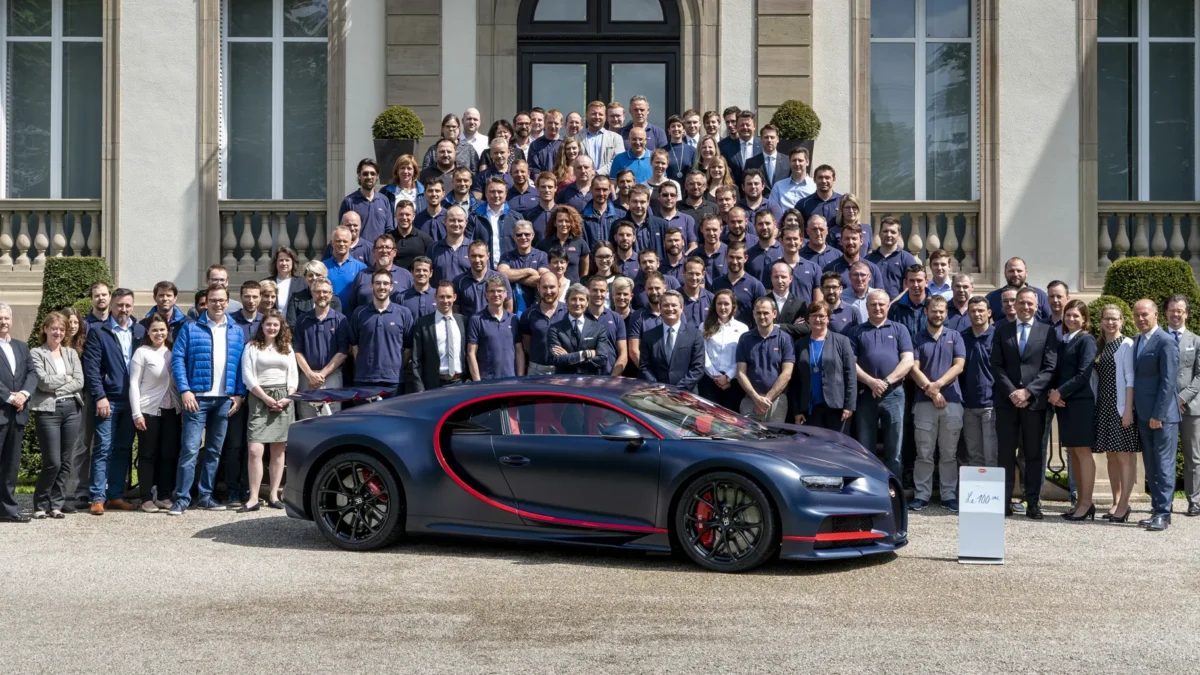
For 28 years, Bugatti was a passion project paid for by Volkswagen. As of late April, it is a portfolio asset paid for by a New York venture firm that also has stakes in Anthropic and SpaceX, alongside an Abu Dhabi private equity outfit founded in late 2024. The Volkswagen era of Bugatti — the Veyron, the Chiron, the entire “Ferdinand Piëch wanted a 1,000-horsepower car so he got one” chapter of supercar history — is officially over.
On 24 April, Porsche AG signed papers selling its 45 percent stake in the Bugatti Rimac joint venture, plus its 20.6 percent stake in the parent Rimac Group, to a consortium led by HOF Capital with BlueFive Capital as the largest investor. Bloomberg reported the joint venture had been valued at just over €1 billion in earlier offer talks. Mate Rimac, the Croatian wunderkind who started by building electric Volkswagen Beetles in his garage, now has full operational control. Porsche — which is to say Volkswagen, since Porsche AG is itself majority-owned by the VW Group — is gone.
Why now? Because Porsche is in genuine financial trouble. The brand reported a 92.7 percent collapse in operating profit, weighed down by a €3.9 billion charge — of which roughly €2.4 billion was earmarked for new product development. Q1 operating profits were down 22 percent year-on-year. US tariffs are biting. Chinese demand has cratered. The company that made Bugatti possible can no longer afford to indulge it. CEO Michael Leiters’ statement was the corporate equivalent of leaving a note on the kitchen table: “With the sale of our stake, we demonstrate that we will focus Porsche on the core business.” In other words, we have problems, and a hand-built French hyperc with 16 cylinders and a leather-trimmed key fob is not the solution to them.
It’s worth pausing on what Volkswagen actually did for Bugatti. The brand had been resurrected, briefly, by an Italian called Romano Artioli, who built it a beautiful factory and then went broke. Volkswagen bought the corpse in 1998 and gave it to Piëch, who decided that what the world urgently needed was a road car capable of 250 mph with the structural integrity of a small bridge. The Veyron, launched in 2005, lost money on every car — reportedly between €4 and €6 million per unit — and Volkswagen kept building it anyway because Piëch wanted it built. The Chiron continued the tradition. The Tourbillon, currently being developed, is supposed to be the next chapter.
That is not how private equity thinks. Private equity thinks about IRR, exit timelines, and operational leverage. HOF Capital manages over $10 billion in AUM and has backed Anthropic and SpaceX — it is, in other words, exactly the sort of firm that knows how to nurture growth. BlueFive Capital, despite its $15 billion AUM, is barely 18 months old. Both have said the right things. Hisham Elhaddad of HOF spoke of “heritage and innovation.” Hazem Ben-Gacem of BlueFive called Bugatti “a monument to automotive obsession.” These are lovely words. They are also exactly what you would expect a private equity executive to say at a press conference, and not necessarily what guides decisions in a quarterly investment committee meeting four years from now when the Tourbillon is over budget.
Mate Rimac himself is the variable that might make this work. He is the rare modern founder who is genuinely a car person — the Nevera he built is the world’s quickest production EV, and he had the audacity to make a preliminary bid for Porsche’s stake himself last year. With Porsche out, he now answers to investors who have explicitly framed the deal as “more than simply a financial transaction,” while also being, definitionally, a financial transaction. He gets the keys. He also gets new bosses who measure success rather differently to Wolfsburg.
The practical implications are significant. Bugatti’s Veyron and Chiron parts supply has historically depended on the Volkswagen Group’s component-sharing infrastructure. The Veyron’s key fob — a famously expensive item — was a VW group fob. Suspension components, electronics, and various fiddly bits were sourced from a parts bin shared with Audis and Lamborghinis. That arrangement may well continue commercially, but the assumption that Bugatti owners will enjoy decades of factory support backed by the deepest pockets in European motoring is no longer a given. As Doug DeMuro put it on his podcast this week, “Volkswagen had the money to spend to keep stuff around for the Veyron. I don’t see that happening going forward.”
What does this mean for Bugatti as a brand? In the short term, very little. The Tourbillon is still being developed. Mate Rimac is still in charge. The factory in Molsheim still smells of expensive leather. In the medium term, the question is whether Bugatti continues to operate as Volkswagen’s halo project — unconcerned with profit, devoted to engineering excess — or whether it begins to behave like a brand that needs to justify its existence to a spreadsheet every quarter. The two things are not the same.
Lamborghini, by contrast, remains under Volkswagen Group ownership. Bentley too. Porsche has divested only Bugatti and Rimac, focusing on what it now calls the “core business” — 911s, Cayennes, Macans, the things that actually pay the bills. Audi is busy losing money in Formula 1. The VW group’s pyramid of brands, which once stretched from Škoda at the bottom to Bugatti at the very pointy top, has had its summit politely lopped off and sold to people who use words like “AUM” without flinching.
A car company built around the principle that money was no object has been bought by people for whom money is, at minimum, an object of considerable interest. Whether that ends up being good for Bugatti rather depends on whether HOF Capital wants to own the next Veyron or the next exit.