In 1968, Zora Arkus-Duntov — the Belgian-born engineer who had more or less invented the Corvette’s performance identity and who remains, fifty years after his retirement, the car’s patron saint — presented General Motors management with a proposal for a mid-engine Corvette. The proposal was detailed, the engineering was sound, and the prototype he had built to support it was, by contemporary accounts, genuinely extraordinary.
GM said no.
They said no again in 1969, in 1972, in 1973, in the mid-1980s, in the early 1990s, and at various points in between. The mid-engine Corvette became the most persistent rejected proposal in American automotive history — a ghost that haunted every new Corvette generation, raised hopefully by engineers and dispatched firmly by accountants, for half a century.
The C8, launched in 2019 and on sale from 2020, is a mid-engine Corvette. It took General Motors fifty-one years to say yes. The question worth asking is not why it finally happened, but why it took so long — and whether the answer reflects well on anyone involved.
Why Duntov Wanted It
Zora Arkus-Duntov’s case for a mid-engine layout was the same case that Ferrari, Lamborghini, and Porsche were making simultaneously on the other side of the Atlantic: physics. A mid-engine layout places the heaviest single component of the car — the engine — as close to the car’s centre of gravity as possible. The result is lower polar moment of inertia, which translates directly to how quickly and accurately a car responds to steering inputs. A front-engine car, however well engineered, carries weight that is structurally disadvantaged relative to the ideal.
Duntov had spent his career extracting performance from a front-engine platform. He had done it brilliantly — the C2 Sting Ray and C3 were genuinely fast, genuinely capable cars that competed credibly with European machinery. But he understood, better than anyone at GM, exactly how much was being left on the table by the layout, and he wanted to stop leaving it there.
The CERV I and CERV II — experimental research vehicles Duntov developed in the early 1960s — were both mid-engine designs. They were quick enough to embarrass production cars from any manufacturer. They also demonstrated, conclusively, that GM’s engineers knew how to build a mid-engine car. The knowledge was there. What was lacking was the will to use it.
Why GM Said No. Repeatedly.
The reasons GM gave for rejecting successive mid-engine proposals were not always the same, but they clustered around a consistent set of concerns.
The first was cost. A mid-engine layout requires a fundamentally different chassis architecture from a front-engine car. You cannot evolve a front-engine platform into a mid-engine one incrementally — you start again. Starting again is expensive, and the Corvette, for all its cultural significance, was never GM’s highest-volume product. The business case for a ground-up redesign around a different layout was difficult to construct in a way that satisfied the finance department.
The second was practicality. American buyers, GM’s product planners argued, expected a certain amount of luggage space. A mid-engine layout restricts what you can do with the rear of the car — the engine is where the boot would otherwise be. European buyers, who had grown up with mid-engine Ferraris and Lamborghinis, had apparently made their peace with this. American buyers, the argument went, had not.
The third concern, rarely stated explicitly but present in the background of every rejection, was identity. The Corvette’s front-engine, rear-drive layout was not just a technical specification. It was what the car looked like, what it sounded like from the bonnet, what it meant to the people who bought it. Changing the layout was changing the car in a way that went beyond engineering.
This third concern was the most honest one. It was also, ultimately, the least defensible.
The Prototypes That Never Were
The archive of mid-engine Corvette proposals and prototypes that never reached production is long enough to be its own article. The CERV II begat the XP-882 of 1969 — a fully driveable mid-engine prototype shown publicly at the New York Auto Show, greeted with enormous enthusiasm, and subsequently cancelled. The XP-895 followed in 1973, a mid-engine concept with a Reynolds Aluminium body. The Aerovette of 1977 was sufficiently developed that Duntov, by then retired, believed it would finally reach production. It did not.
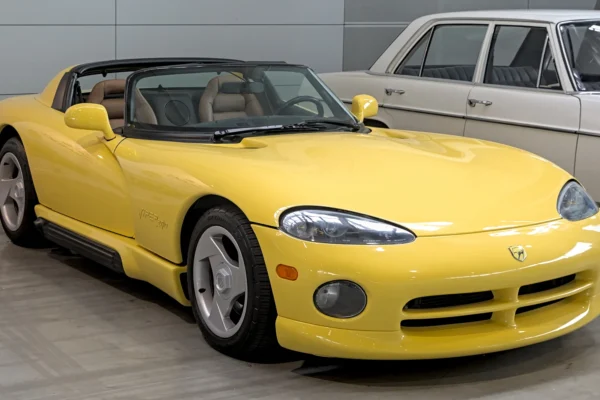
Through the 1980s and 1990s, the mid-engine question resurfaced with each new Corvette generation. Each time, the engineering teams developed concepts. Each time, the concept stalled before reaching production commitment. The other great American sports car defined by what its engineers refused to compromise on — the Viper — at least had the honesty of its convictions. The Corvette spent half a century knowing what it should be and building something else.
The C5, launched in 1997, was a front-engine Corvette with a torque tube connecting the engine to a rear-mounted transaxle — a configuration that improved weight distribution significantly without changing the fundamental layout. It was an excellent car and a partial answer to the problem. It was not a mid-engine Corvette.
What Finally Changed
The C8 programme, which began in earnest in the early 2010s under chief engineer Tadge Juechter, was different from its predecessors for one fundamental reason: GM management committed to it.
The factors that enabled this commitment were several. The Corvette had, by the 2010s, accumulated a performance record that made the case for further investment straightforward. The Z06 and ZR1 variants of the C6 and C7 were genuinely world-class performance cars, competitive with European machinery at twice the price. The brand equity was there. The customer base was engaged. The question was whether to keep extracting from the existing formula or to reset it.
Juechter’s team argued for the reset. They argued that the front-engine layout had been developed as far as it could usefully go — that the gains available from further refinement were diminishing, and that the only way to take the Corvette to the level of the Ferrari 488 and McLaren 570S was to adopt the layout those cars used. The argument was made with data, with prototypes, and with a business case that the finance department could not dismiss.
GM said yes. For the first time in fifty-one years, they said yes.
What the C8 Actually Is
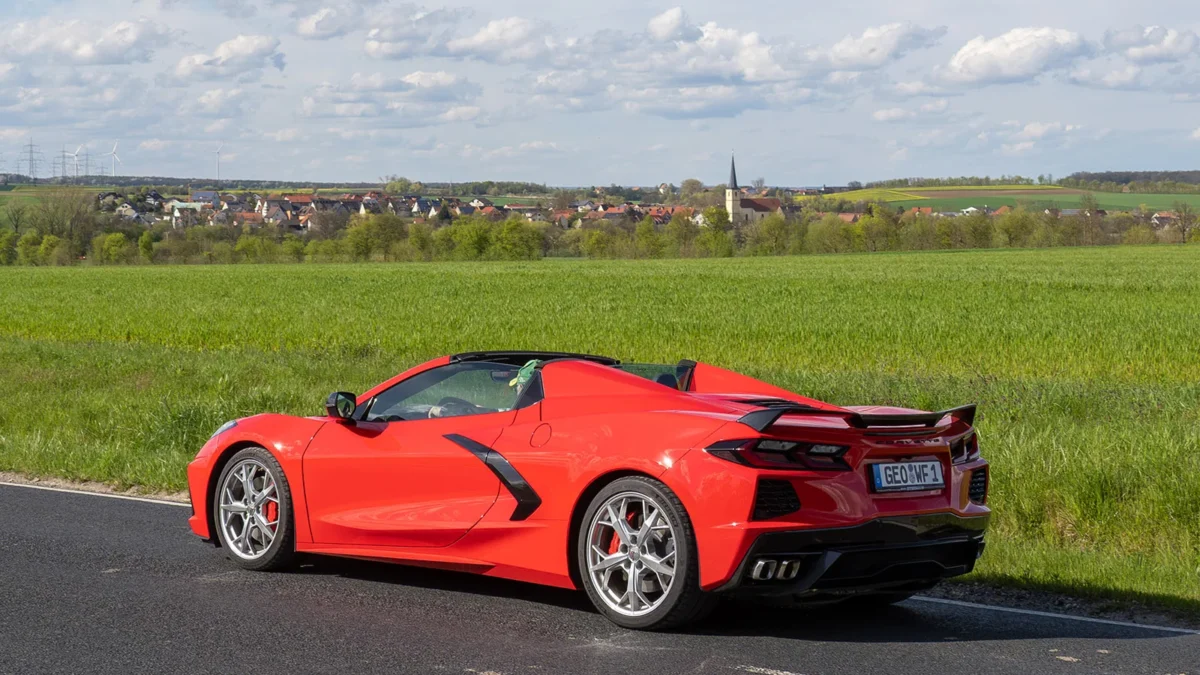
The production C8, with its 6.2-litre naturally aspirated V8 mounted behind the driver and producing 495 horsepower in base specification, is not merely a better Corvette than its predecessor by degree. It is a categorically different car — one that competes directly with mid-engine European sports cars at less than half their price and wins most of the comparisons.
Road testers who drove both the C7 Z51 and the C8 Stingray back-to-back reported that the difference in dynamic behaviour was dramatic. The C8 steers with a directness and balance that the front-engine car, for all its development, could not match. The weight distribution — 40/60 front to rear — is closer to ideal than any front-engine Corvette had achieved. The car does what Duntov spent thirty years trying to make it do.
America had already proved it could beat Europe at its own game when it chose to — the GT40’s Le Mans victories established that beyond argument. The C8 is a different kind of proof: quieter, more considered, arrived at through half a century of internal argument rather than one man’s fury at a failed acquisition. It is what the Corvette was always going to be, once GM ran out of reasons to delay it.
What It Tells Us
The Corvette’s mid-engine journey is a study in institutional inertia — the capacity of large organisations to know the correct answer and decline to act on it for reasons that sound reasonable in individual meetings and look increasingly difficult to defend in aggregate.
Duntov was right in 1968. His successors who made the same argument in the decades that followed were right too. The engineers who built the CERV prototypes, the XP-882, the Aerovette, were right. They were overruled, repeatedly, by concerns about cost and identity and the preferences of imaginary customers who turned out, when finally offered the mid-engine car they had allegedly never wanted, to buy it in significant numbers.
The C8 is the car the Corvette should have been in 1973 or 1983 or 1997. It arrived in 2020, fifty-one years after Duntov first asked.
It was worth the wait. It should not have taken that long.