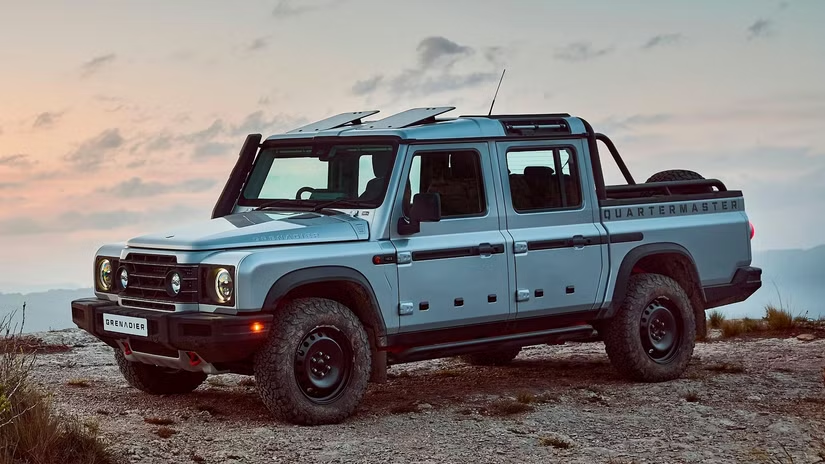
There is a particular type of vehicle that car enthusiasts describe as “characterful” when what they actually mean is “deeply annoying to drive but impossible not to love.” The Ineos Grenadier Quartermaster has been squarely in that category since it launched. It had the recirculating ball steering of a 1970s Land Rover, the aesthetic of a 1970s Land Rover, and the general intention of a company that built a 1970s Land Rover and didn’t entirely apologise for it. The steering, specifically, was the thing that kept appearing in reviews like an inconvenient relative at a dinner party — you could work around it, but it was always there.
For 2026, Ineos has fixed the steering.
Not replaced it, to be clear. The recirculating ball setup remains, because the Grenadier’s off-road character depends on it. What Ineos has done is fit a new variable-ratio steering box, delivering quicker, more precise response around the straight-ahead position for on-road driving, while retaining the existing slow ratio at full lock to preserve off-road capability. The turning circle has been reduced by approximately 5% thanks to revised steering stops. A new variable-ratio steering box is fitted for the first time, delivering a firmer, more precise feel around the straight-ahead position. Ineos says this improves stability at speed and confidence during lane changes and overtaking, while retaining the existing steering characteristics at full lock.
The effect, according to Straight Pipes’ Jacob and Yuri who drove the updated Quartermaster, is transformative enough to remove the issue from the conversation entirely. They describe no longer being bothered by it. Given that the steering was, in their previous Grenadier review, the single element that genuinely concerned them about the vehicle’s roadworthiness, this is not a small development.
The Quartermaster, for those unfamiliar with the backstory, is the pickup truck variant of the Grenadier — a vehicle that Sir Jim Ratcliffe and Ineos built on the premise that Land Rover had stopped making the Defender properly and someone needed to step in. The result is a body-on-frame, ladder-chassis, solid-axle, mechanically honest off-roader that runs a BMW B58 turbocharged three-litre inline-six producing 282 horsepower and 332 lb-ft of torque, paired with a ZF eight-speed automatic. The Quartermaster starts at $86,395 in the US, where prices remain unchanged for 2026, with the SUV version starting at $72,995. That the engine is BMW-sourced is, in 2026, beginning to look less like a quirk and more like a strategic asset — while Volvo Cars admits it can’t build engines anymore and outsources its powertrains to whichever supplier will take the contract, Ineos quietly secured one of the best inline-sixes on the market before that game got crowded.
For that money, you get three locking differentials on the Trialmaster specification — centre, front, and rear — a Tremec-built heavy-duty transfer case, 10.4 inches of ground clearance, solid beam axles with coil suspension, and the ability to wade through 800mm of water. You do not get a 360-degree camera. You get a standard reverse camera with good resolution and a high frame rate. You do not get electronically adjustable drive modes. You get high and low range. You do not get a power-adjustable bed or a deployable load ramp. You get a bed. These omissions are, in the context of the vehicle’s philosophy, entirely intentional.
What you also get, in 2026, is hard switches. Physical buttons. Dials. An HVAC system operated by controls mounted directly on the dashboard rather than buried in a touchscreen menu. A key that you put in an ignition and physically turn. These things, which were standard across the entire car industry approximately eight years ago, have become, in 2026, a genuine premium differentiator. People are paying for them. The Straight Pipes presenters note, with some bemusement, that in the current market you are effectively paying more money specifically for less technology, and finding this absolutely correct.
The Quartermaster also has a BMW-sourced infotainment system — the same rotary-dial interface found in the Toyota Supra and various other BMW-adjacent products — with wireless CarPlay and an off-road mode that displays elevation changes, compass heading, and terrain statistics that the Straight Pipes’ reviewer’s son apparently cannot stop looking at. This is a reasonable response.
The remaining friction point in the 2026 Quartermaster is the driver monitoring system, which beeps when you look away from the road and cannot currently be permanently disabled — unlike the speed limit warning, which Ineos has addressed with a permanent off switch for North American vehicles. Ineos has indicated an OTA update to address the driver monitoring issue may be forthcoming. This is, in the context of a vehicle that otherwise treats its owner as a competent adult, an anomaly rather than a defining characteristic.
A new Black Edition has also been added for 2026, available on both the station wagon and Quartermaster, adding $3,995 to either vehicle and committing fully to the concept by offering it only in black paint. No black accents on other colours. Just black. This is the kind of decision that indicates a company that understands what it is making and who is buying it.
Ineos is a small company relative to the manufacturers it is effectively challenging, and the Grenadier programme’s ability to respond to feedback quickly is, as the Straight Pipes team observes, genuinely impressive. Most large manufacturers discover a problem, form a committee to discuss it, commission a study, and fix it in three model years. Ineos identified the steering issue from reviewer feedback and fixed it in two. The company that Land Rover allegedly took to court in an attempt to prevent the Grenadier from reaching production has, in its third year on sale in the United States, quietly become one of the more interesting vehicle propositions in the market.
At $86,395 for the base Quartermaster in the US, it is not cheap. Against a Ford Ranger Raptor or a Jeep Gladiator Mojave, the value case requires some justification. Against a Mercedes G-Class pickup — which costs more, carries less, and does not exist — the Quartermaster is an obvious bargain. And as Ford struggles with F-150 aluminum supply, the broader truck segment is starting to look less like a stable comparison set and more like a market where the legacy players are quietly fighting fires the newcomers don’t have to worry about.
The steering works now. The rest of it always worked. Run out of reasons to wait.