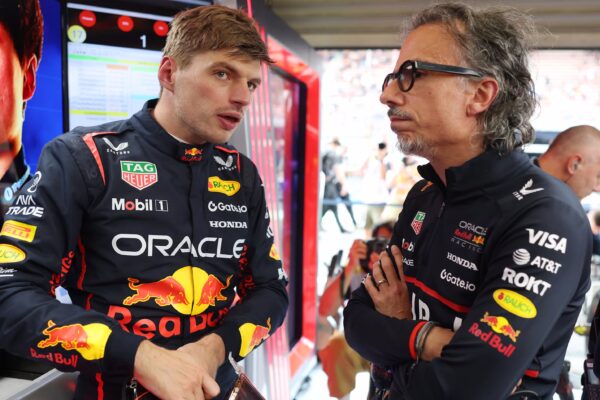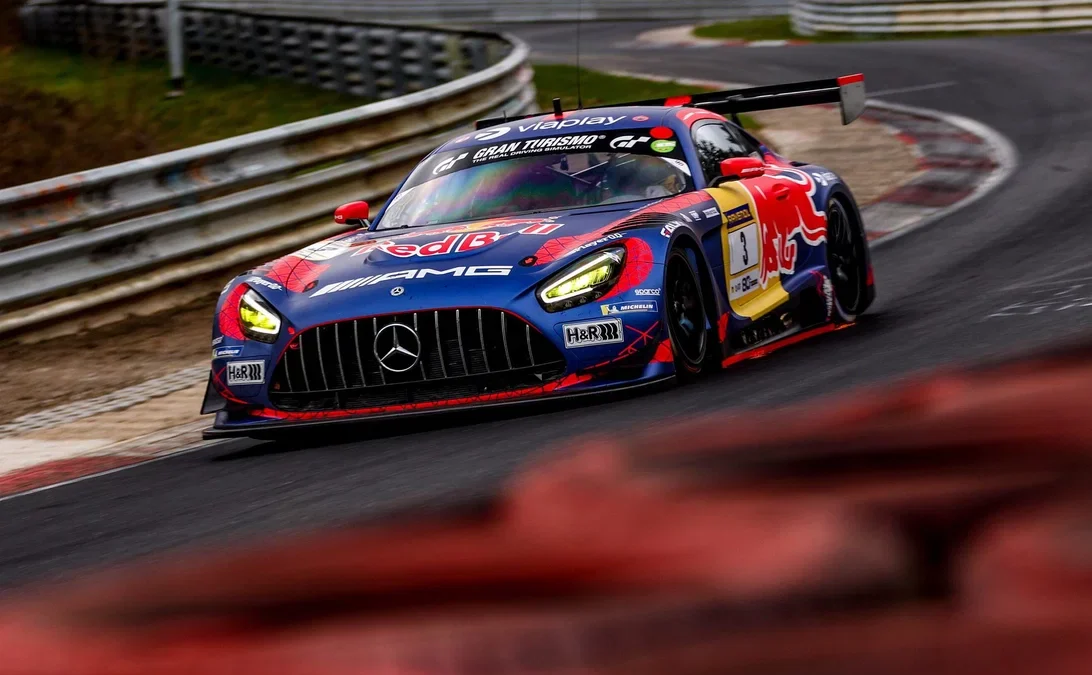
This weekend the four-time Formula 1 world champion will not be racing in Formula 1. He will be at the Nordschleife, driving a Red Bull-liveried Mercedes-AMG GT3 around the most demanding 25.378-kilometre stretch of tarmac on Earth, for 24 hours, for fun. Tickets sold out for the first time in the event’s 56-year history. The reigning champion of F1 is the reason. This is not, on any reasonable reading, where the sport’s biggest star should be in mid-May.
Verstappen qualified third in the opening qualifying session at Nürburgring on Thursday afternoon, posting an 8m18.539s in the #3 Verstappen Racing Mercedes-AMG GT3 he is sharing with Lucas Auer, Jules Gounon and Dani Juncadella. He was beaten by Fabian Schiller’s #80 Mercedes by 3.6 seconds and Raffaele Marciello’s #1 ROWE Racing BMW. The relevant numbers for context: the Nordschleife has 154 corners. Verstappen has, by his own admission, ten in-anger laps in this car on this circuit before today. He is leading a four-driver lineup that includes a former DTM champion, a Bathurst winner, and a man who has won the Nürburgring 24 twice. He looks entirely at home.
Which brings us to the awkward part. Verstappen is also currently the reigning F1 world champion. And he is winless in 2026. Kimi Antonelli has taken three of the first four rounds. Mercedes lead both championships. Ferrari brought eleven upgrades to Miami and — in former Ferrari race engineer Rob Smedley’s word, this week — looked “soul-destroying.” The Red Bull-Ford partnership is in its first season together, the Ford-branded power unit is not winning races, and Verstappen has spent the year complaining about the new F1 hybrid regulations with such consistent vehemence that earlier this season he warned he might walk away from the sport entirely. He is now, as it happens, away from the sport entirely. For five days. Apparently because he wants to be.
Here’s what’s properly interesting. He is not alone in wanting to be there.
“It was the most fun I’ve had all year to be honest,” said Lando Norris in Miami, after he and Oscar Piastri got their first taste of the Nordschleife during a tyre test in a McLaren 750S. The reigning F1 world champion. Most fun all year. George Russell has reportedly asked Toto Wolff if he can run an F1 car around the Nordschleife to attempt the all-time lap record — Wolff has, equally reportedly, said no. Antonelli, the championship leader, is openly plotting his path to obtaining a Nordschleife A-permit, having previously raced a Mercedes GT3 with his father’s team. “I would love to do an endurance race with Max together,” he said earlier in the year. Oliver Bearman has confirmed he’ll be watching the race. So has Russell. It is, by some distance, the most enthusiastically endorsed non-F1 race in modern F1 memory.
This is not a coincidence. This is symptomatic.
The 2026 F1 regulations have produced cars that the drivers, by and large, do not enjoy driving. The 50:50 hybrid split forces them into long stretches of “super clipping” — lifting off in order to harvest energy — that turns the cars into expensive moving battery management exercises. Bearman’s 50G crash at Suzuka was the most visible symptom; the FIA has spent the spring frantically tweaking the rules in response, including yesterday’s confirmation that the 50:50 ICE/ERS split will be scrapped for 2027 in favour of a 60:40 weighting (a +50kW ICE increase, a -50kW ERS reduction, plus a fuel-flow bump). Translation: the FIA has admitted, on the record, that the cars need to be more about engines and less about batteries.
The Nordschleife, of course, is the opposite of all of this. There is no battery management. There is no “super clipping.” There is a 6.2-litre Mercedes-AMG V8 producing 600-odd horsepower behind the driver, 24 hours of racing, and 25.378 kilometres of asphalt that has been killing people since 1927. It is, in every conceivable sense, the antidote to whatever F1 has become.
The forward-looking part of this story is rather more concerning for Formula 1 than the immediate optics of its biggest star spending a weekend elsewhere. Ford has now formally confirmed it is in active talks with Verstappen about a Le Mans 24 Hours entry, potentially as soon as 2027. “Discussions go back three-plus years,” Ford global motorsport boss Mark Rushbrook told the press last week. “Depending on the schedules, it could be during [Verstappen’s F1 career] or both [during and after his F1 stint].” Verstappen, who is contracted to Red Bull until the end of 2028, has long publicly wanted Le Mans. He had originally planned to enter with his father Jos and Fernando Alonso. The Ford partnership now makes it considerably more likely to actually happen.
What does this all mean? A few things, none of them comfortable for F1.
First, when the dominant driver of his generation finds his recreational racing more rewarding than his day job, that is a structural problem, not a personal preference. Verstappen has won four consecutive world titles. He is 28. He is rich enough to do whatever he wants. He is choosing, with increasing frequency, to do this. Second, his fellow F1 drivers are not envious of his lifestyle, they are envious of his racing. There is a difference. Third, sold-out tickets for a 56-year-old endurance race because the F1 world champion is competing tells you something important about where motorsport’s centre of gravity is currently located.
Verstappen will likely not win Nürburgring 24 this weekend. He is third on Q1 pace, his car is up against works-supported entries with vastly more experience, and the race is famously unpredictable in the kind of weather the Eifel is currently producing. But he will, by all available evidence, have a marvellous time. So will several million viewers, including a measurable proportion of the current Formula 1 grid. The Canadian Grand Prix is in eight days. Nobody is currently selling out anything for that.