The Cannonball Run was invented by a man who believed the national speed limit was an affront to personal liberty, and who proceeded to prove his point by driving coast to coast as fast as possible. Over fifty years later, a Tesla has just completed the same journey — and the only affront to personal liberty is that the driver had almost nothing to do.
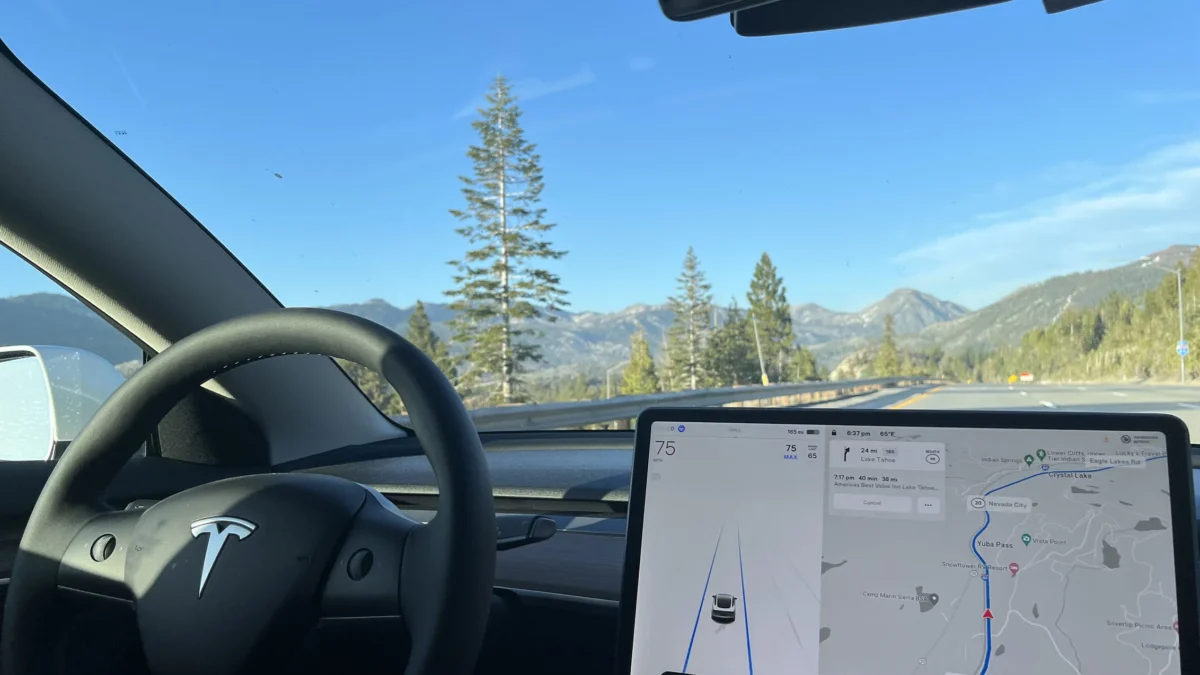
A Tesla Model 3 completed the New York City to Los Angeles Cannonball route on Saturday using Tesla’s Full Self-Driving (Supervised) software with zero human interventions across 2,833 miles. Not one. Not a single tap of the wheel, press of the brake, or moment of panicked grabbing at the controls on a Los Angeles freeway — which, if you have driven on a Los Angeles freeway, is a rather more impressive statement than it might initially appear. The run was made possible by FSD version 14.3.2, released in late April 2026, which introduced upgraded reinforcement learning, an improved neural network vision encoder for low-visibility conditions, and a completely rewritten AI compiler that delivers approximately 20% faster reaction times.
The technical element that separates Saturday’s run from its predecessors is not the mileage. The previous record was set by Alex Roy and a team in January 2026, covering the reverse Los Angeles-to-New York City route in 58 hours and 22 minutes across 3,081 miles — also with zero interventions. But Roy’s run did not include autonomous parking at charging stops. Drivers manually positioned the vehicle at Superchargers. Saturday’s run was different. Version 14.3.2 adds autonomous parking capability, which means the car navigated to the Supercharger, positioned itself, and charged — without human involvement. The driver did not need to plug in. The driver did not need to do very much at all, beyond sitting there being legally responsible for the vehicle. It is, one imagines, a peculiar feeling.
The update also unifies Tesla’s FSD model across consumer FSD, Actually Smart Summon, and Robotaxi deployments, producing more consistent behaviour across modes — a detail that matters considerably beyond the Cannonball record. If the same underlying model drives your car on the motorway, parks it at a Supercharger, and operates the Cybercab robotaxi fleet, the improvement in one area is, in principle, an improvement across all three. That is a meaningful architectural shift rather than a party trick. It also means the Model Y that this FSD software runs on is, increasingly, less a car and more a delivery vehicle for the software stack — a point its reviewers have been making for some time, not always charitably.
It is also worth acknowledging what “zero interventions” does and does not mean. Tesla’s Full Self-Driving remains, legally and technically, a supervised driver assistance system. The driver must remain attentive and ready to intervene. Saturday’s achievement is that intervention was not required — not that it was not legally required. That distinction matters. A fully unsupervised system, where the driver can genuinely check out for the duration, remains the goal rather than the current reality. Regulators in Europe and the United States are still working through the frameworks that would permit such a thing commercially, and several of those conversations are moving at a pace that makes the Cannonball Run look brisk.
What Saturday’s drive does demonstrate, persuasively, is that the gap between “supervised but never intervened” and “unsupervised” is narrowing faster than the sceptics expected. Alex Roy — who set the January record and responded publicly to Saturday’s achievement — noted that FSD records are now following the same pioneer-to-optimisation pattern as classic Cannonball runs, and that Tesla is currently the only platform capable of the feat. Coming from Roy, who is not naturally inclined toward uncritical enthusiasm, that assessment carries weight. It also will not stay true forever — Lucid’s challenge to Tesla’s autonomy lead, in the form of a 35,000-vehicle robotaxi commitment with Uber, is the first genuinely serious attempt by another American manufacturer to play on the same field. Tesla is alone today. By 2027 it almost certainly will not be.
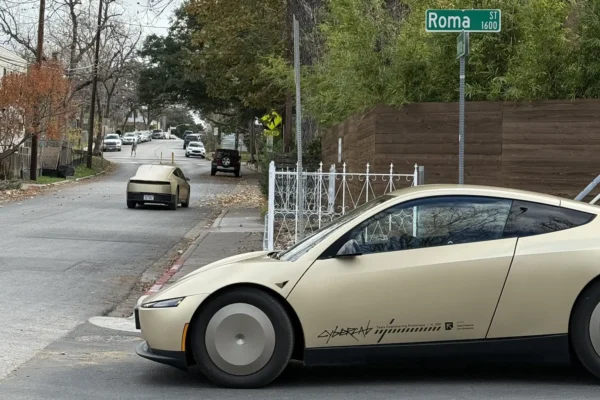
The Cybercab, meanwhile, is in pilot production at Gigafactory Texas. The Cybercab’s full Austin metro expansion has now extended unsupervised robotaxi service across the city without reported incidents, with Dallas and Houston following close behind. And FSD has just driven itself coast to coast, parked itself at chargers, and arrived in Los Angeles without anyone touching the wheel. There is something to be said for the contrast: the Fremont factory where the Model S was just retired is now retooling for robotaxi production, the company has quietly moved past the car that defined it, and while the Roadster still has no production date, the software it was supposed to launch alongside has crossed the United States on its own.
Brock Yates, who invented the Cannonball Run, drove the original route in a Ferrari Daytona. He would probably have several views about autonomous vehicles. One suspects, however, that he would have been curious about the lap time.