In 1961, Carroll Shelby was a racing driver with a heart condition that had ended his career and a idea he couldn’t fund. He wanted to build an American sports car — lightweight British body, thunderous American V8, nothing else. The concept was simple. The execution required convincing two companies to contribute the core components of the car without either of them fully understanding what the other was agreeing to.
He pulled it off.
The AC Problem
AC Cars, a small British manufacturer based in Thames Ditton, Surrey, had a problem of their own. Their AC Ace — a lightweight aluminium-bodied roadster with a tubular steel chassis — was running out of engine. The Bristol six-cylinder unit they had been using was going out of production, and AC needed a replacement power source or the Ace would die with it.
Shelby knew about AC’s engine problem. He wrote them a letter — by most accounts a remarkably confident letter given that he had no concrete deal in place — asking whether they would supply him with bodies and rolling chassis if he could find a suitable American V8 to fit. AC, facing the alternative of a discontinued model, agreed in principle.
Shelby now had half a car. He needed an engine.
The Ford Problem
Ford was in the middle of what would become its Total Performance era — a period of aggressive motorsport investment designed to shift the brand’s image from family transport to performance machines. They were spending money on racing programmes and looking for partners who could help them win. The era also produced the Ford-Ferrari grudge that followed — a useful reminder that Ford’s appetite for performance partnerships in the early 1960s was less a passing strategic phase than a defining decade. It was also, as it happens, the same corporate moment in which Lee Iacocca was building the boardroom case for the Mustang — a car that would launch three years later into a Ford already reshaped by the performance identity Shelby and the GT40 programme were helping to construct.
Shelby approached Ford with the same pitch he had given AC, inverted. He had, he told them, a chassis from a British manufacturer ready to accept an American V8. Would Ford supply the engine? The car would carry Ford power in competition. The marketing value would be Ford’s.
Ford agreed. They shipped Shelby a small-block V8 on a short-term loan basis to see whether the project was viable.
At this point, AC knew about Shelby but not about Ford’s specific involvement. Ford knew about Shelby but not about the full nature of the AC arrangement. Shelby was the only person who held the complete picture, and he moved quickly before either party could ask questions the other’s answer might complicate.
The First Car
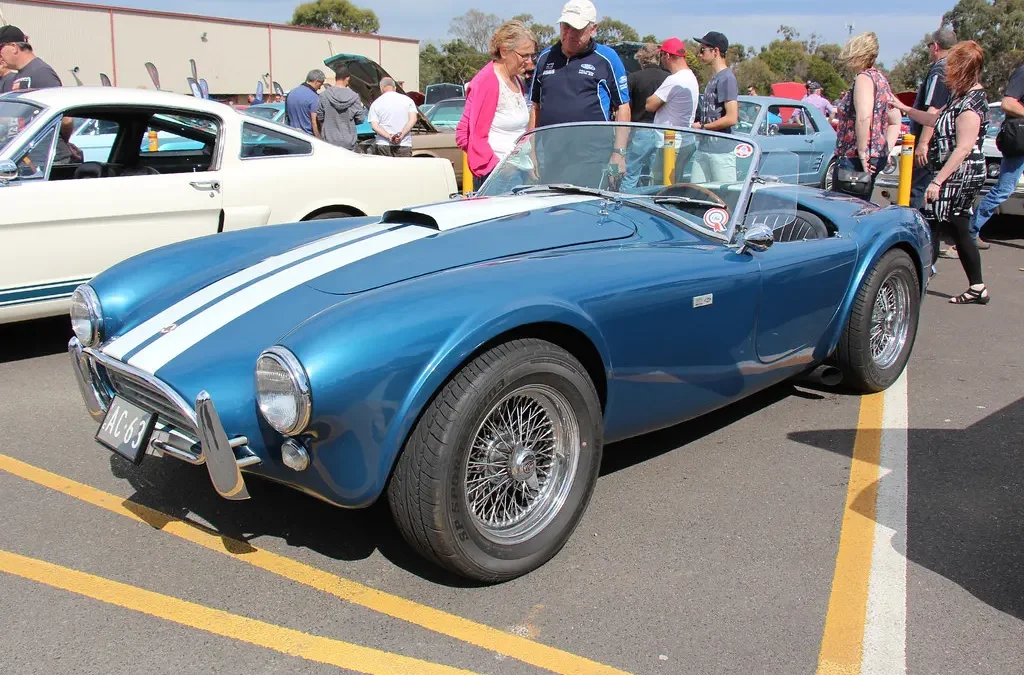
The first Cobra — CSX 2000 — was assembled in Shelby’s rented garage in California. The Ford V8 fit into the AC chassis with modifications that were, depending on who tells the story, either straightforward or heroic. The car was tested, proven quick, and shown to both Ford and AC as evidence that the concept worked.
By the time either company fully understood the arrangement, it was already successful. Ford deepened their involvement, eventually supplying the larger 427 cubic inch V8 that turned the Cobra from a quick sports car into something approaching a road-legal weapon. AC continued to supply bodies and chassis, gradually becoming more integrated into what was now a functioning production operation.
Shelby, who had started with no factory, no capital, and no confirmed supply of either major component, had a car in production within months of his original letters. The early 1960s were, in retrospect, a remarkable moment for cars born of personal conviction rather than corporate planning — Ferruccio Lamborghini’s parallel grudge against Enzo was, at almost exactly this moment, producing the V12 that would become the Miura. Different continents, different motivations, the same era of stubborn individuals building cars the established industry hadn’t asked for.
What the Cobra Actually Was
The Cobra’s reputation rests on its performance — the 427 version remains one of the fastest accelerating cars ever built, with a power-to-weight ratio that modern supercars struggle to match. But its real achievement is organisational as much as mechanical.
Shelby assembled a car from two companies on different continents, neither of which had signed a comprehensive agreement with the other, in a garage he didn’t own, funded partly on the strength of relationships and partly on the sheer momentum of his own conviction. The Cobra exists because Carroll Shelby was willing to start building before he had permission, and fast enough that the permission arrived before anyone had cause to refuse it.