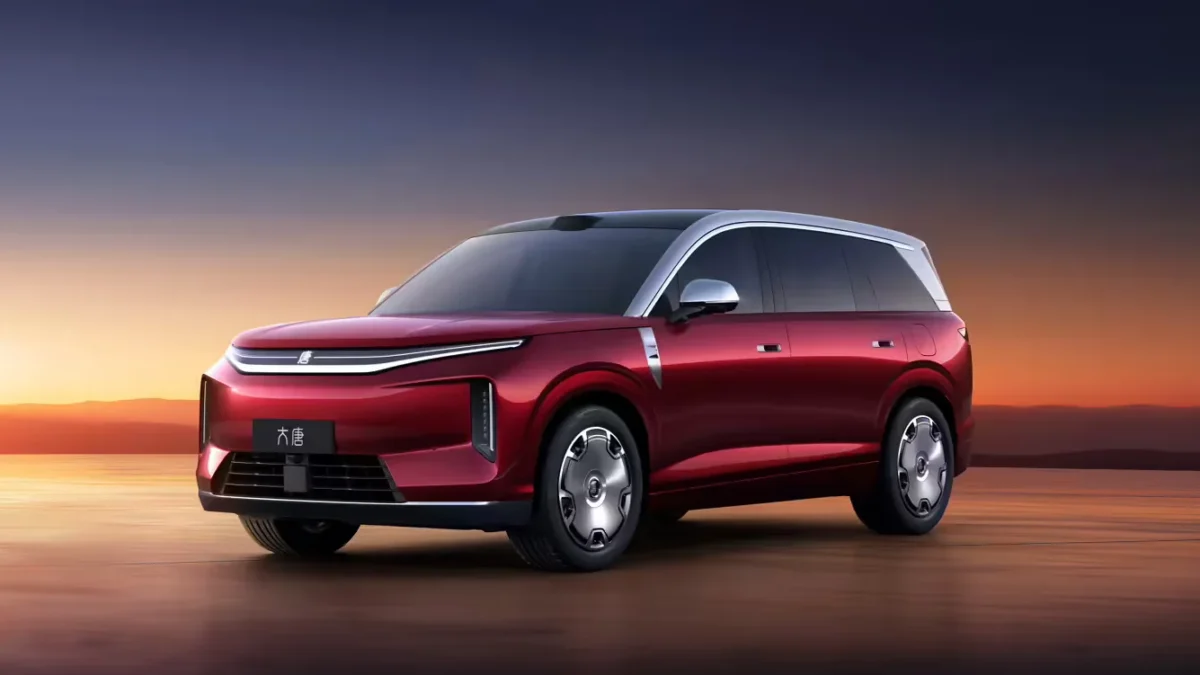
On the opening day of the 2026 Beijing Auto Show, BYD opened pre-sales of its new Great Tang SUV — a seven-seat electric SUV with a claimed 950km of range, sub-ten-minute flash charging capability, 0-100km/h in 3.9 seconds, starting from approximately $36,200. That is, in British money, roughly £28,000. For context, a base BMW iX1 — a somewhat smaller, considerably less dramatic electric SUV — costs around £48,000 in the UK. Volkswagen’s ID.4 starts at £42,000. The Great Tang is not a comparable vehicle. It is better. And it costs less.
Let us dwell on the 950km range figure for a moment, because it deserves it. That is approximately the distance from London to Rome. On a single charge. In a seven-seat SUV that also costs less than most three-bedroom family hatchbacks in Western Europe. BYD is describing the Great Tang as the flagship of its range, built around the company’s new second-generation Blade Battery technology — the same platform underpinning BYD’s flash charging network, which the company is targeting to reach 20,000 stations by end of year. The range figure is under China’s CLTC testing cycle, which is more generous than Europe’s WLTP — so real-world figures will be lower. They will still be extraordinary. The wider Chinese battery story is moving in step: CATL’s new sodium-ion deal — the largest sodium-ion order ever signed, anywhere — confirms that the chemistry roadmap behind cars like the Great Tang is broader, deeper, and considerably further ahead than most Western commentary has caught up with. The Germans are not standing still either, mind: how the BMW i3 stacks up against BYD’s range claims is the question Munich has now answered with a 563-mile WLTP figure on its new electric sedan, which on a like-for-like cycle conversion actually closes some of the gap the Great Tang opens. Some. Not all.
The Great Tang is not even the most attention-grabbing thing BYD unveiled today. Also debuting at Beijing was the Formula X from BYD’s off-road sub-brand Fang Cheng Bao — a two-door convertible supercar with a golden ratio silhouette, 19 aerodynamic vents, active electric rear spoiler, and “Infinite Ring” taillights. It is the kind of car that would generate a full feature in every major automotive magazine if Ferrari had built it. BYD built it. It is scheduled for production next year. The Formula X is also a useful data point for anyone still parsing China’s broader premium-segment offensive: a Chinese off-road sub-brand is now building a convertible supercar, which is not the behaviour of an industry content to compete on the cheap end of the market. It is also worth setting against how the luxury EV segment is shaping up at the very top end — Ferrari has just confirmed the Luce, its first electric car, with Jony Ive’s design fingerprints on it, which suggests even Maranello has now accepted that the premium electric conversation is no longer something it can sit out.
The wider show is similarly relentless. Volkswagen Group alone is launching more than 20 electrified vehicles in China in 2026, expanding to 50 models by 2030, all developed under its “in China, for China” strategy. Hyundai unveiled the Ioniq V — a new electric model developed specifically for the Chinese market by Hyundai’s China Design Centre, integrating CATL batteries, Qualcomm’s flagship cockpit chips, and Baidu’s AI systems. Leapmotor opened European orders for its B05 hatchback at €26,900 on the same day, having delivered over 110,000 vehicles globally in Q1 2026 alone.
The cumulative effect of Beijing 2026 is difficult to overstate. This is not a show about what might be possible in five years. These are vehicles in pre-sale today, arriving in showrooms this year, at prices that the Western automotive industry has spent a decade insisting were impossible. The argument that Chinese EVs are cheap and nasty budget alternatives has become harder to maintain with each passing month. The argument that they are technologically inferior is no longer being made by anyone who has looked at a spec sheet recently.
Back in the United States, GM’s Factory Zero remains on its second shutdown of the year. Ford has cancelled its electric truck. The political consensus has moved against EV incentives and the market has responded accordingly. Meanwhile, BYD is taking pre-orders for an SUV that goes from Beijing to Shanghai on a single charge, and Leapmotor is selling a hatchback in Europe for under €27,000.
The Western automotive industry is not losing a price war. It is losing an engineering war, a technology war, and a manufacturing war simultaneously, in public, at the world’s largest auto show. The only thing missing from the BYD Great Tang’s launch is a polite note to everyone else suggesting they might want to have a think.