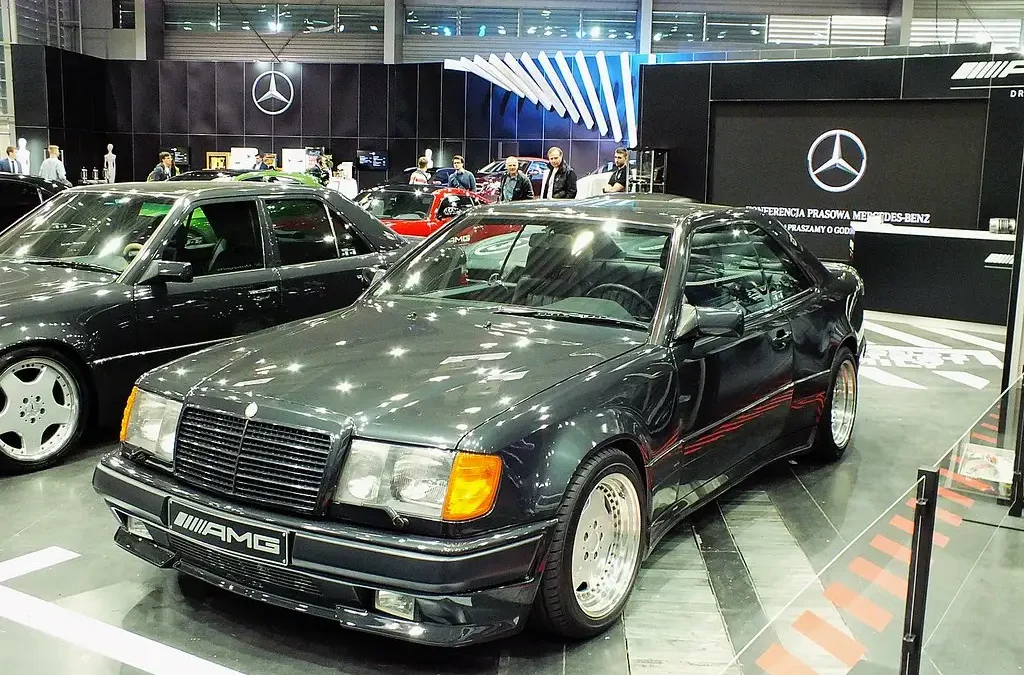
In 1986, the fastest production car a driver could buy from a German manufacturer was not a Porsche. It was not any variant of the 911. It was a four-door Mercedes saloon that, to a casual observer, looked indistinguishable from the kind of car driven by regional sales directors and airport chauffeurs.
The AMG 300 E 5.6 — universally known as the Hammer — had a 5.6-litre V8 producing around 370 horsepower. It completed 0–60 mph in approximately five seconds. Its top speed was 305 km/h. The Ferrari Testarossa, launched the previous year to global fanfare and considerable press coverage, produced 390 horsepower and managed 0–60 in around 5.8 seconds. The Testarossa cost three times as much and looked exactly like what it was.
The Hammer looked like nothing in particular. That was partly the point.
What AMG Did to the W124
The Mercedes-Benz W124 was the E-Class of its generation — launched in 1984 as a thoroughly competent, thoroughly sensible executive saloon. It was well-built, comfortable, reliable, and about as exciting as a well-built, comfortable, reliable executive saloon tends to be. The standard engine lineup ranged from modest four-cylinders to a smooth inline-six. None of them were fast.
AMG took the W124 300 E — powered in standard form by a 3.0-litre inline-six producing 180 horsepower — and replaced the engine. Not upgraded it. Replaced it, with a 5.6-litre V8 from the Mercedes S-Class, significantly modified by AMG with a new cylinder head, revised valve timing, and recalibrated management systems.
The result produced figures that were not supposed to be possible in a family saloon. The power went in through a four-speed automatic gearbox. The suspension was stiffened and lowered. The brakes were upgraded to cope with the additional speed. The exterior was modified with subtle bodywork changes — a small front spoiler, a discreet rear lip, wider tyres filling the arches slightly more assertively than the standard car.
From a distance of ten metres, you could mistake it for an ordinary 300 E. At 300 km/h, the distinction became academic.
The Sleeper Philosophy
The Hammer occupied a specific cultural space that no other car quite filled at the time. The performance car market of the mid-1980s operated on spectacle. The Ferrari Testarossa was spectacle. The Lamborghini Countach was spectacle. These were cars designed to announce themselves, to make their performance visible at a distance, to communicate what they were through every design element.
The Hammer did none of this. Its performance was invisible until it was moving. The car that pulled alongside you at a traffic light looked like a company car. The car that was disappearing into the distance before you had time to react was something considerably more difficult to categorise.
This quality — what enthusiasts call sleeper status — was not entirely accidental. AMG’s customer base in the mid-1980s was wealthy, discreet, and often professional. They wanted performance that was real rather than advertised. They did not necessarily want the attention that a Testarossa invited. The Hammer delivered exceptional performance wrapped in the appearance of absolute conventionality, which was exactly what that customer wanted.
What It Cost
The Hammer was not cheap, but its pricing followed a logic that AMG’s customers understood. The base W124 300 E in 1986 cost approximately $39,500. AMG’s modification package — which included everything from the engine transplant to the suspension work to the interior upgrades — added approximately $98,000. The finished car cost around $137,000 in 1986 terms, equivalent to over $375,000 today.
For that money, buyers received the fastest four-door production car in Germany. They also received a car that required no announcement of the fact. The Hammer’s owners knew what they had. Nobody else needed to.
The Significance for AMG
The Hammer was the moment AMG’s reputation in the United States crystallised. The car was featured extensively in the American automotive press, which had been broadly unfamiliar with AMG’s work. The combination of Mercedes build quality, extraordinary performance, and total visual restraint was unlike anything the American market had encountered.
Sales followed the coverage. AMG’s profile in North America grew substantially after the Hammer. When Daimler-Benz formalised their cooperation agreement with AMG in 1990 — allowing AMG products to be sold through official Mercedes dealerships — the Hammer’s reputation was part of what justified the arrangement.
In the longer arc of AMG’s history, the Hammer sits between the Red Pig — the racing saloon that established credibility — and the modern performance division that produces the C63, the GT, and the One. It was the car that proved AMG could make road-going saloons as devastating as their race cars, and could do it without changing what the car looked like.
The fastest German car of 1986 looked like it was on its way to pick someone up from Heathrow.