The Bugatti Veyron cost €1,000,000 at launch in 2005. By the time the final Super Sport edition reached customers, prices had climbed to €2.4 million. It sold 450 units over nine years. By conventional automotive accounting, it should have been enormously profitable.
Instead, Volkswagen Group is widely reported to have lost approximately €5 million on every single car they sold. The total loss over the production run has been estimated at over €1.5 billion. These numbers have never been officially confirmed by VW, but they have never been officially denied either, and multiple senior executives have over the years made comments that validate the rough scale of the figure.
The question is not whether Volkswagen lost money on the Veyron. They almost certainly did. The question is why they built it anyway.
The Brief
When Ferdinand Piëch — then chairman of Volkswagen Group and one of the most formidable automotive engineers of his generation — approved the revival of the Bugatti brand in 1998, he set a performance target that his own engineers initially considered impossible.
The car had to reach 400 km/h (248 mph). It had to produce 1,000 horsepower. And it had to be driveable — not a stripped-out race car, but a grand tourer a person could use on public roads, with air conditioning, luggage space, and a ride quality that didn’t destroy its occupants.
No engine in existence could deliver 1,000 horsepower in a road-legal package. No tyres in production could safely operate at 400 km/h. The cooling requirements for an engine of that output, in a car that size, had no precedent. Piëch’s engineers told him this. He reportedly told them to solve it.
The Engineering Cost
What followed was one of the most expensive automotive development programmes ever undertaken outside of Formula One.
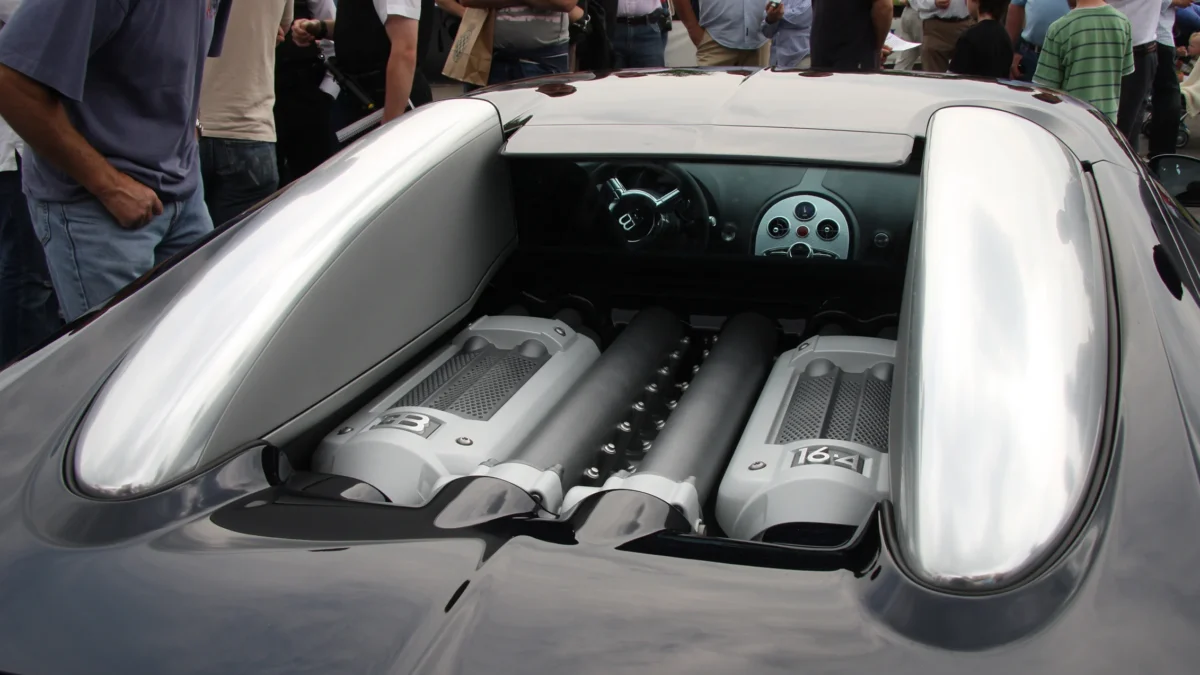
The W16 engine — effectively two narrow-angle V8s sharing a common crankshaft — was designed from scratch. Michelin developed a new tyre compound specifically for the Veyron, capable of operating safely at speeds that no production tyre had previously needed to reach. The tyres cost approximately €25,000 per set and needed replacement every 15,000 km. The full service, which required removing the body from the chassis, cost around €17,000 at a Bugatti dealer.
The car required ten radiators to manage its thermal output. Its fuel consumption at full speed was sufficient to empty the tank in roughly twelve minutes. The aerodynamic components — the rear wing, the underbody diffuser, the deployable air brake — were developed in a wind tunnel over multiple years.
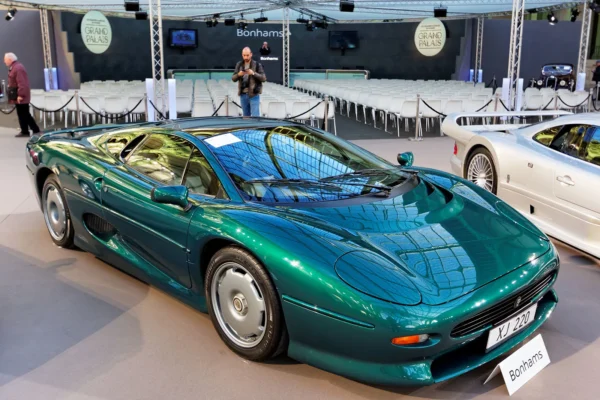
Every single element of the Veyron required bespoke engineering. There were no shared platforms, no borrowed components, no economies of scale. Building each car was essentially a bespoke manufacturing exercise repeated 450 times. Jaguar had already learned that lesson the hard way with the XJ220 — a car that began with a promised V12 and ended with a twin-turbocharged V6 because the development bill ran beyond what Coventry could underwrite, and customers spent the early 1990s in court rather than at speed. Piëch had the advantage of a parent company with rather deeper pockets than Jaguar’s in 1992, and the willingness to use them. The Veyron was built on the assumption that the bill would be enormous and that paying it was the entire point.
Why VW Did It
Piëch’s reasoning operated on two levels, one explicit and one implied.
The explicit rationale was brand. Volkswagen Group had acquired Bugatti, Lamborghini, Bentley, and Audi in a period of aggressive expansion. Each acquisition required a statement of intent — proof that VW could steward a prestige marque credibly. For Bugatti, with its heritage of record-breaking pre-war machines, the statement needed to be definitive. A car that merely competed with Ferrari or Porsche would not have been sufficient. A car that redefined what was technically possible was.
The implied rationale was Piëch himself. He was a man who built his career on engineering achievement — he had led the development of the Porsche 917, the Audi Quattro, and the VW Golf GTI in earlier roles. The Veyron was, among other things, a personal proof of concept. He wanted to know if it could be done. The commercial case was secondary to the engineering question.
In this sense, the losses were not a miscalculation. They were the cost of asking the question.
The Chiron and What Came After
The Veyron’s successor, the Chiron, launched in 2016 with 1,500 horsepower and a theoretical top speed of 420 km/h. It sold for €2.4 million. Bugatti almost certainly continued to lose money on it, though the margins may have improved with the learnings from the Veyron programme.
In 2021, Volkswagen sold Bugatti to Rimac Automobili — the Croatian electric hypercar startup — as part of a joint venture. The official reasoning involved strategic fit and electrification. The unofficial reading, offered by several automotive analysts at the time, was that VW had decided the era of the combustion-engined halo car had run its course, and that continuing to fund Bugatti’s losses no longer served the brand-building purpose it once had.
If that reading is correct, it suggests that VW always knew the Veyron programme was finite, and always understood its losses as an investment with a defined purpose rather than an ongoing commercial model. The car existed to prove something. Once proven, the logic of continuing to fund it at the same scale began to dissolve.
What It Was Worth
The Veyron’s commercial failure and engineering legacy are inseparable. The car that loses millions per unit is the same car that proved a 1,000-horsepower road car was possible, pushed tyre and materials technology forward by measurable degrees, and reset the hypercar benchmark for a generation of competitors.
Koenigsegg, Hennessey, and eventually Bugatti’s own successor all chased figures the Veyron had established. The losses were real. So was the influence.
Sometimes the most important products are the ones that make no financial sense at all.