Colin Chapman died in 1982, aged 54, before most of the people who now cite his influence were born. In the forty-plus years since, his reputation has only grown. Engineers at every major Formula One team work with concepts he originated. The monocoque chassis, the stressed-member engine, ground effect aerodynamics — each of these ideas reshuffled what was considered possible in motorsport. Each came from Chapman’s desk at Lotus.
His philosophy was encapsulated in a phrase he reportedly used often: Simplify, then add lightness. It sounds like a bumper sticker. In practice, it was a engineering doctrine that produced seven F1 Constructors’ Championships and defined the trajectory of racing car design for half a century.
It was also responsible for some of the most dangerous cars in the history of the sport.
Who He Was
Chapman was born in 1928 in Richmond, Surrey, the son of a pub landlord. He studied structural engineering at University College London, left without completing his degree on time, joined the Royal Air Force briefly, then built his first car in a garage behind his girlfriend’s parents’ house in Muswell Hill in 1948. The car was a modified Austin Seven. He entered it in local trials events and won.
From that beginning, he built a company — Lotus Engineering, founded 1952 — that would win the Indianapolis 500, six Formula One Drivers’ Championships, and produce road cars that are still studied by engineers for their handling dynamics. He did all of this in thirty years before a heart attack took him at his desk.
His ability to think laterally about structures — to see what was unnecessary and remove it, to find the solution that did the job with the minimum possible material — was described by contemporaries as almost instinctive. Where other designers started from what existed, Chapman started from what was required.
The Innovations
Chapman’s list of engineering firsts in Formula One is remarkable not just for its length but for its influence.
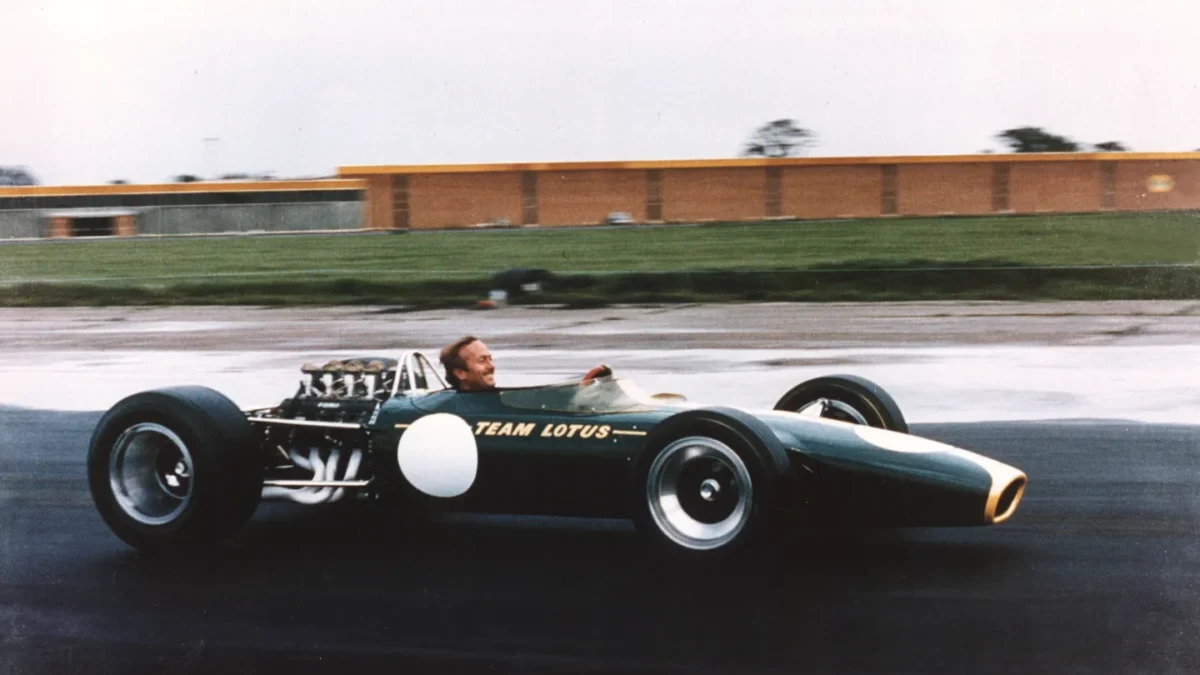
The Lotus 25, introduced in 1962, was the first F1 car to use a monocoque chassis. Before the 25, racing cars were built around a separate tubular frame with bodywork attached. Chapman’s monocoque — a structure in which the outer shell carries the structural load, like an aircraft fuselage — was lighter, stiffer, and stronger. Jim Clark drove it to the 1963 World Championship, winning seven of ten races.
The Lotus 49, in 1967, introduced the concept of the engine as a stressed member of the chassis. The Ford Cosworth DFV engine was bolted directly to the monocoque at the front and carried the rear suspension at the back. The engine was not just an engine; it was a structural component. This eliminated the need for a separate rear subframe, saving weight and improving rigidity simultaneously. Every modern Formula One car uses this concept.
The Lotus 72, in 1970, introduced wedge-shaped aerodynamics and side-mounted radiators, setting a template that competitors followed for years. The Lotus 78 and 79, in 1977 and 1978, exploited ground effect — using the underside of the car as an inverted wing to generate downforce by creating a low-pressure zone beneath the vehicle. Mario Andretti won the 1978 World Championship in the 79. The concept was so effective that the FIA eventually banned it.
Each of these innovations became standard. Each was developed at Lotus before anyone else had thought to try it.
The Dark Side
The same logic that made Chapman’s cars fast also made them dangerous. Lightness requires removing material. Removing material reduces safety margins. Chapman was not reckless — he was not indifferent to his drivers’ safety — but his engineering decisions consistently prioritised performance, and the consequences were sometimes fatal.
Jim Clark, widely considered the greatest racing driver of his generation, died in 1968 in a Formula Two race at Hockenheim, driving a Lotus. Chapman reportedly told people he had lost his best friend. Jochen Rindt died at the 1970 Italian Grand Prix while driving a Lotus, becoming the only posthumous Formula One World Champion in history. Graham Hill, Mike Spence, and others suffered serious accidents in Lotus machinery.
The criticism of Chapman’s engineering was not that he was negligent. It was that the ratio of performance to safety margin was calibrated differently at Lotus than at other teams. Critics — including some who worked with him — argued that the cars were on the edge of what was structurally viable, and that the edge was sometimes crossed.
Chapman’s response, where documented, was essentially that racing was dangerous, that drivers knew what they were doing, and that the pursuit of performance was the point. This was not an unusual position for a team principal of his era. But the losses accumulated.
The Road Cars
On the road car side, Chapman’s philosophy produced some of the most beloved driver’s cars in British automotive history. The Lotus Seven, the Elan, the Europa, the Esprit — each one light, responsive, and focused on the connection between driver and machine.
The Lotus Esprit achieved a kind of cultural immortality when it appeared as a submarine in the 1977 James Bond film The Spy Who Loved Me. It remains one of the most recognisable British sports cars ever made. It was also, in the tradition of Chapman’s road cars, built on the principle that an adequate engine in a light car will outperform a powerful engine in a heavy one.
Lotus’s road car engineering also influenced others in ways Chapman might not have anticipated. The original Tesla Roadster was built on a modified Lotus Elise platform. Elon Musk later purchased the actual submarine Esprit from The Spy Who Loved Me at auction. Chapman’s ideas about lightweight construction and efficient engineering became, decades after his death, part of the foundation of the electric vehicle industry.
The End
Chapman died on 16 December 1982, before he could face the consequences of his involvement in the DeLorean financial scandal — a separate, complicated story involving alleged misuse of British government funds channelled through a company linked to Lotus. Whether he would have been prosecuted, and what the outcome would have been, remains unknown.
Conspiracy theories that he faked his death and fled to South America have circulated for decades. They are almost certainly false. But the fact that they persist speaks to something real: Chapman was the kind of figure whose life contained enough genuine drama that the rumours felt plausible.
What is not disputed is what he built. The cars. The innovations. The engineering culture that produced champions and influenced the design of every racing car that came after.
Simplify, then add lightness. Forty-three years after his death, the phrase still accurately describes what the best engineers in motorsport are trying to do.