Most car companies worry about whether their latest model will get a good review in What Car?. Tesla is currently worrying about whether its showroom in Dubai will still be standing by Thursday morning.
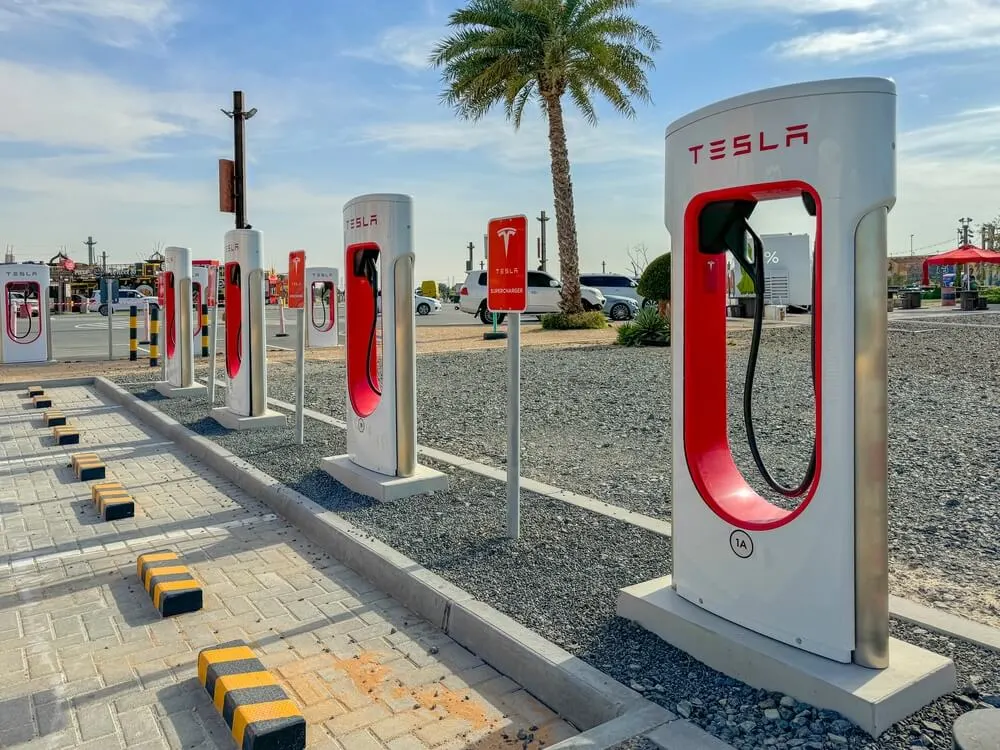
Iran’s Islamic Revolutionary Guard Corps has named Tesla among 18 U.S. companies whose Middle East operations it is threatening to attack, in retaliation for the killing of Iranian military leaders. The threat carries an explicit deadline: 8:00 PM Tehran time on April 1. Tesla has been rapidly expanding across the Gulf over the past year, with showrooms, service centers, and more than 30 Supercharger stations now operating in the UAE, Saudi Arabia, and Qatar — all directly in the crosshairs.
The company finds itself in rather unusual company. The list also features Cisco, HP, Intel, Oracle, Microsoft, Apple, Google, Meta, IBM, Dell, Palantir, Nvidia, JPMorgan Chase, General Electric, Boeing, Spire Solutions, and UAE-based AI firm G42. Most of those companies are there for entirely logical, if alarming, reasons — defence contracts, cloud infrastructure supporting military operations, AI systems with obvious dual-use applications. Tesla, by contrast, makes electric cars and sells them to wealthy Gulf residents who appreciate the instant torque and the bragging rights. Its inclusion is, on the face of it, peculiar.
The IRGC’s justification centres on the claim that these technology and AI companies play a direct role in “planning and tracking targets” for U.S.-Israeli military strikes against Iran. Tesla has no defence contracts. It operates no intelligence systems. It sells EVs and installs Superchargers at shopping centres. The more obvious explanation for Tesla’s place on the list is that its CEO, Elon Musk, financed Donald Trump’s election with more than $200 million in donations and has since become the most visible symbol of American political and technological power. When you want to make a point about America, Tesla is, in 2026, a very legible target.
The IRGC’s one-kilometre evacuation warning underscores the nature of the threat. Several Tesla Supercharger locations in the Gulf sit at major shopping malls and commercial centres — precisely the kind of densely populated civilian areas where any attack would cause significant collateral damage. This is not, in other words, a precision strike against a military asset. It is a threat against a car charger in a car park. The geopolitical implications of that sentence take a moment to fully land.
The threat follows Iranian drone strikes that damaged several Amazon data centres in the UAE and Bahrain in early March, suggesting these are not entirely empty warnings. The IRGC has demonstrated both the willingness and the capability to act against commercial infrastructure in the region. Tesla’s Gulf operations now exist within that threat envelope whether they like it or not.
For Tesla as a business, the immediate consequences are manageable — the Gulf accounts for a tiny fraction of global revenue, and IT spending in the region was projected to hit $169 billion in 2026 before anyone started doing considerably grimmer maths. But the reputational and strategic implications are harder to dismiss. Tesla has positioned the Gulf as a key growth market, and its rapid expansion there — showrooms, service centres, a growing Supercharger network — now looks less like a shrewd bet on a wealthy and EV-curious region and more like a liability that arrived faster than anyone planned for.
There is also a broader question worth asking. The EV industry’s global expansion has always assumed a relatively stable geopolitical backdrop — open supply chains, accessible markets, international goodwill. What happens to that expansion model when a major EV brand’s infrastructure becomes a symbolic target in an active military conflict? Tesla won’t be the last EV company to discover that selling cars in geopolitically sensitive regions comes with geopolitically sensitive consequences.
The Superchargers will almost certainly still be there on Thursday. Probably. But the era in which an EV brand could expand across the Middle East without thinking very carefully about what it represents has, without much warning, come to an end.
Key Stats Referenced
- 18 U.S. companies named on IRGC target list
- 30+ Tesla Supercharger stations operating in UAE, Saudi Arabia, and Qatar
- Elon Musk donated $200M+ to Trump’s 2024 election campaign
- Amazon AWS data centres in UAE and Bahrain struck by Iranian drones in March 2026
- Regional IT spending projected at $169 billion for 2026
- IRGC deadline: 8:00 PM Tehran time, April 1, 2026